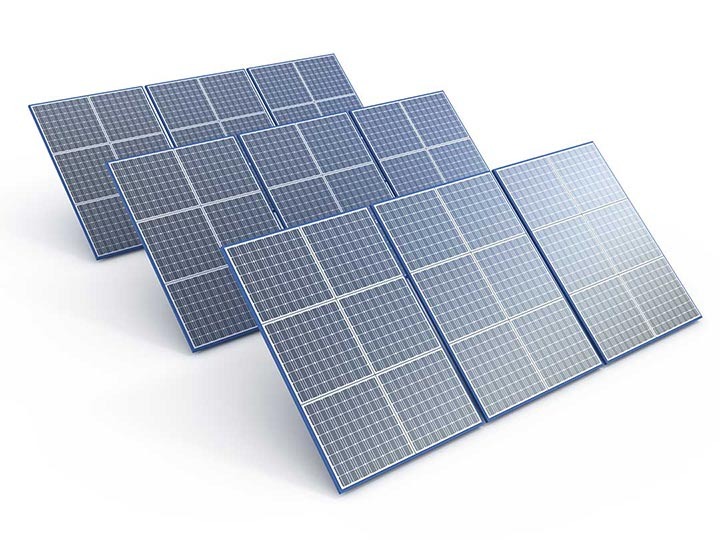
Renewable Solar System
Solar panels collect clean renewable energy in the form of sunlight and
convert that light into electricity which can then be used to provide power
for electrical loads. Solar panels are comprised of several individual solar
cells which are themselves composed of layers of silicon, phosphorous
(which provides the negative charge), and boron (which provides the
positive charge). Solar panels absorb the photons and in doing so initiate
an electric current. The resulting energy generated from photons striking
the surface of the solar panel allows electrons to be knocked out of their
atomic orbits and released into the electric field generated by the solar
cells which then pull these free electrons into a directional current. This
entire process is known as the Photovoltaic Effect. An average home has
more than enough roof area for the necessary number of solar panels to
produce enough solar electricrity to supply all of its power needs excess
electricity generated goes onto the main power grid, paying off in
electricity use at night.